The Book
The Geometry of the Good develops a structural ontology of ethics. It begins from a simple ontological claim: to be is to be in relation. Whenever directed relations obtain between agents, obligations arise.
Ethical obligation is not grounded in rules, contracts, preferences, or cultural consensus. It is a structural feature of relational life itself. Moral systems persist when relational coherence is maintained and collapse when contradiction accumulates without repair.
Ethics is reconceived as a geometric field rather than a normative code: obligations have direction, magnitude, persistence, and decay. Trust functions as infrastructure. Repair restores continuity.
The SimEthica Platform
SimEthica is an agent-based simulation platform developed alongside The Geometry of the Good to formally test, explore, and extend its core claims.
Rather than treating ethical failure as terminal, the platform represents repair as an ongoing structural process. Systems may absorb, resolve, or compound violations over time, producing measurable patterns of stability or rupture.
Explore the platform: SimEthica — empirical ethics in silico →
Core Structural Principles
- Relational Directedness
Obligation arises when relations constrain future possibilities. - Contradiction Debt
Unresolved failures generate accumulating structural tension. - Trust as Infrastructure
Trust enables plural obligations to coexist coherently. - Repair
Repair restores relational coherence after failure. - Diachronic Sensitivity
Obligations persist, evolve, and decay across time.
Agency and Obligation
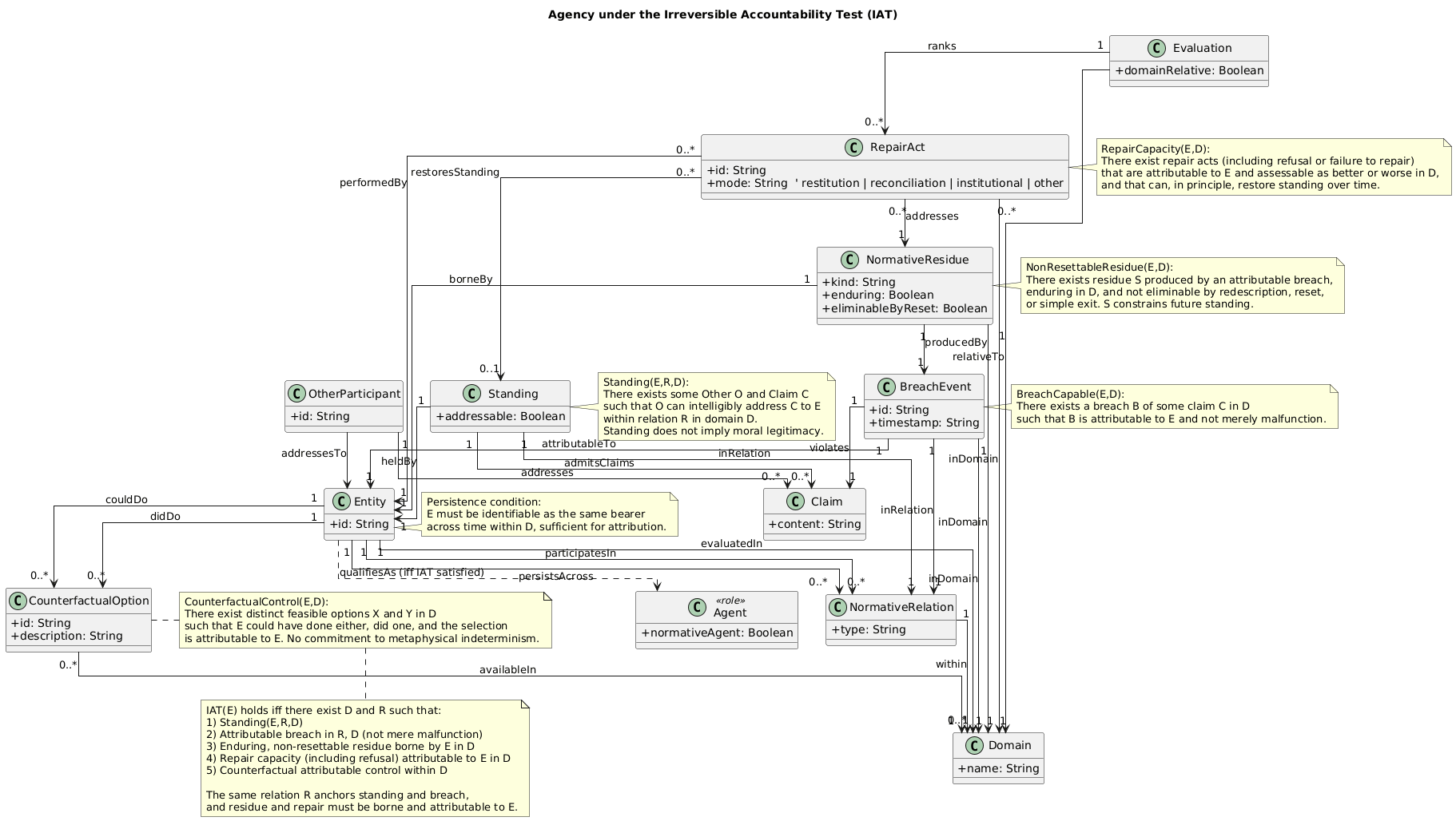
Agency is the condition of being a persisting system whose actions are governed by alterable patterns and whose failures, within a normative relation, are attributable to the system itself and generate non-resettable residue.
Agency is not defined by intention, consciousness, or institutional status. It arises wherever a system could have acted otherwise under constraints that bind outcomes to that system as its own. When such failures occur, they alter the system’s standing across time and make repair intelligible.
Obligation is the structural form taken by these constraints. To be obligated is not to have accepted a rule, but to occupy a position in a relational field where certain futures are no longer available without repair.
The Moral Reasoner
The Moral Reasoner is an interactive diagnostic tool that operationalizes the core ontology of The Geometry of the Good. It does not compute moral verdicts. It makes moral structure visible.
The tool distinguishes two questions that are often conflated. First, whether a system qualifies as a moral agent. Second, what obligations arise from the relations in which systems stand.
Moral agency is assessed using the Irreversible Accountability Test (IAT). A system qualifies as an agent only if its failures generate enduring normative residue that cannot be erased by reset, exit, or re-description, and if that residue is attributable to the system itself.
When these conditions fail, the Moral Reasoner does not deny that harm, obligation, or responsibility exist. Instead, it reveals where those burdens must be borne elsewhere. Institutions, operators, or surrounding systems may inherit obligations even when tools or subsystems cannot.
Apparent contradictions are therefore not errors. They are signals. A breach without residue, a duty assigned to a non-agent, or a denial of recognition in a live relation marks a breakdown in the moral geometry of the situation and indicates where repair or redesign is required.
The Moral Reasoner also incorporates a minimal ontological typing layer to detect category mistakes, such as assigning obligations to roles, events, or instruments rather than to accountable systems.
Launch the Moral Reasoner:
Explore the GoG + IAT Moral Reasoner →
Formalization and Simulation
The Geometry of the Good is implemented in agent-based simulations. Agents emit obligation vectors, fulfill or deny obligations, accumulate contradiction debt, and engage in repair.
Positioning the Framework
Deontology requires universal maxims. Utilitarianism requires outcome aggregation. Care ethics emphasizes responsiveness. The Geometry of the Good formalizes the relational conditions under which obligation itself arises.
Outlook
The Geometry of the Good treats ethics as an emergent relational field capable of explanation, comparison, and formal testing.
Ongoing work extends the framework into legal ontology, institutional repair, and computable normative systems.